

Common Types of Plastic Materials Used in Manufacturing
Introduction
Plastic materials play a critical role in modern manufacturing across industries such as automotive, electronics, medical devices, packaging, and consumer products. Each type of plastic offers unique mechanical, thermal, and chemical properties, making material selection a key factor in product performance and cost control.
In this article, we introduce the most common plastic materials used in manufacturing and explain their properties, advantages, and typical applications.
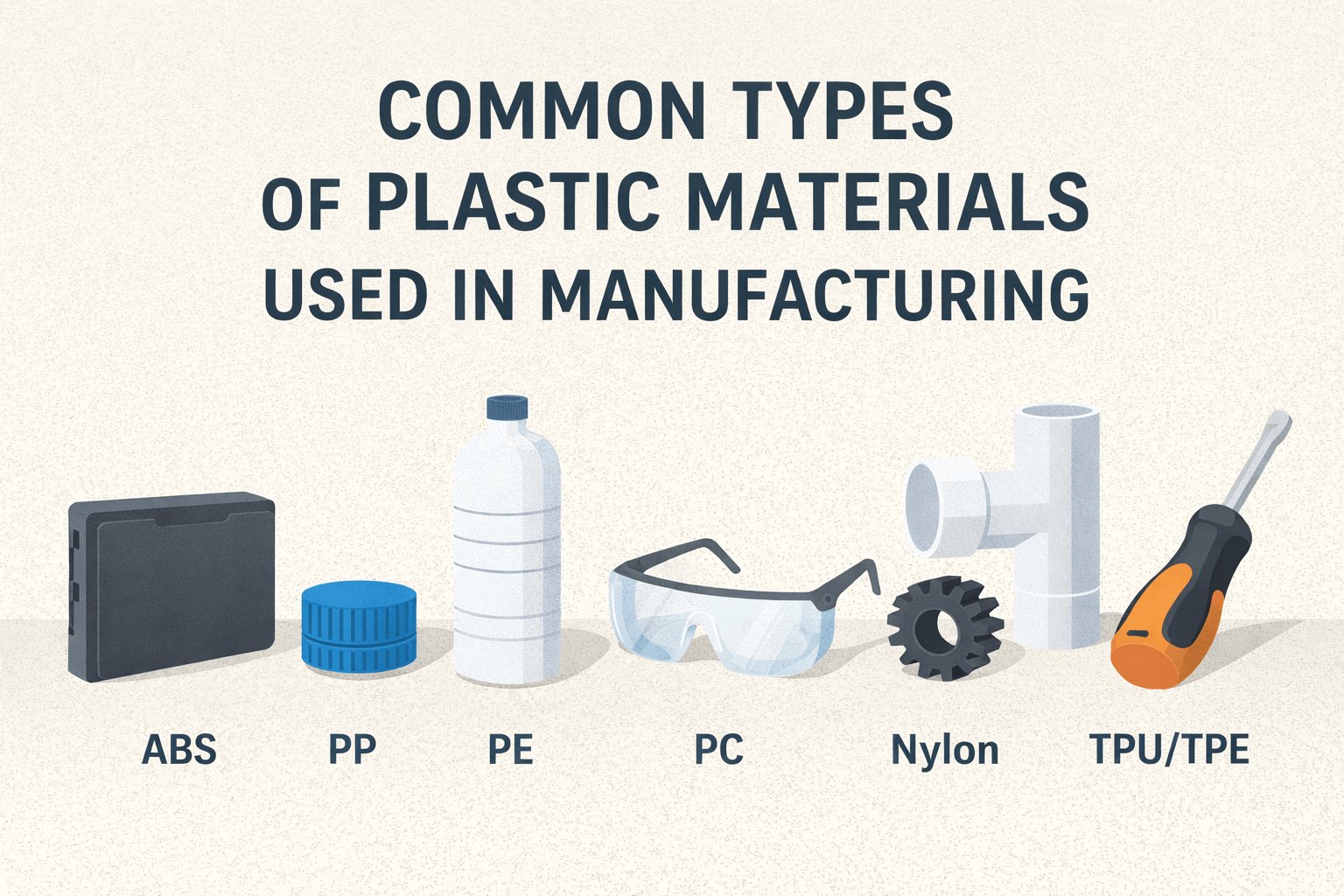
1️⃣ ABS (Acrylonitrile Butadiene Styrene)
ABS is a widely used thermoplastic known for its excellent balance of strength, toughness, and surface finish.
Key Properties:
- High impact resistance
- Good dimensional stability
- Easy to process and mold
- Excellent surface quality for painting and plating
Common Applications:
Electronic housings, automotive interior parts, appliances, toys, enclosures.
2️⃣ PP (Polypropylene)
Polypropylene is lightweight, cost-effective, and highly resistant to chemicals and fatigue.
Key Properties:
- Excellent chemical resistance
- Good flexibility and fatigue strength
- Low density and cost
- Recyclable material
Common Applications:
Packaging containers, caps and closures, household products, automotive components.
3️⃣ PE (Polyethylene)
Polyethylene is one of the most commonly used plastics globally and is available in several forms such as HDPE and LDPE.
Key Properties:
- High toughness
- Good moisture resistance
- Excellent electrical insulation
- Easy to process
Common Applications:
Bottles, pipes, films, containers, plastic bags, industrial packaging.
4️⃣ PC (Polycarbonate)
Polycarbonate is a high-performance plastic known for its transparency and impact resistance.
Key Properties:
- Extremely high impact strength
- Optical clarity
- Good heat resistance
- Dimensional stability
Common Applications:
Medical devices, safety goggles, lenses, lighting covers, electronic components.
5️⃣ Nylon (PA – Polyamide)
Nylon offers excellent mechanical strength and wear resistance, making it ideal for engineering applications.
Key Properties:
- High tensile strength
- Excellent abrasion resistance
- Good heat resistance
- Self-lubricating properties
Common Applications:
Gears, bearings, bushings, automotive parts, industrial components.
6️⃣ PVC (Polyvinyl Chloride)
PVC is available in both rigid and flexible forms and is widely used due to its durability and cost efficiency.
Key Properties:
- Good chemical resistance
- Flame-retardant
- Durable and weather-resistant
- Cost-effective
Common Applications:
Pipes, fittings, cable insulation, profiles, construction materials.
7️⃣ TPU / TPE (Thermoplastic Elastomers)
TPU and TPE combine the elasticity of rubber with the processability of plastics.
Key Properties:
- Excellent flexibility and elasticity
- High abrasion resistance
- Good impact strength
- Soft-touch surface
Common Applications:
Seals, gaskets, grips, wearable products, medical tubing, overmolded parts.
🔎 Material Selection Comparison
| Plastic Material | Strength | Flexibility | Cost Level | Typical Use |
|---|---|---|---|---|
| ABS | High | Medium | $$ | Enclosures, housings |
| PP | Medium | High | $ | Packaging, containers |
| PE | Medium | High | $ | Bottles, pipes |
| PC | Very High | Medium | $$$ | Transparent parts |
| Nylon (PA) | Very High | Low | $$–$$$ | Gears, mechanical parts |
| PVC | Medium | Low–High | $ | Pipes, profiles |
| TPU/TPE | Medium | Very High | $$ | Soft-touch components |
Conclusion
Choosing the right plastic material is essential for ensuring product durability, performance, and cost efficiency. Factors such as mechanical strength, environmental resistance, production volume, and application requirements should all be considered during material selection.
If you are looking for a reliable manufacturing partner for custom plastic parts, we offer professional support from material selection and mold design to mass production.
📩 Contact us today for material advice or a customized quote.